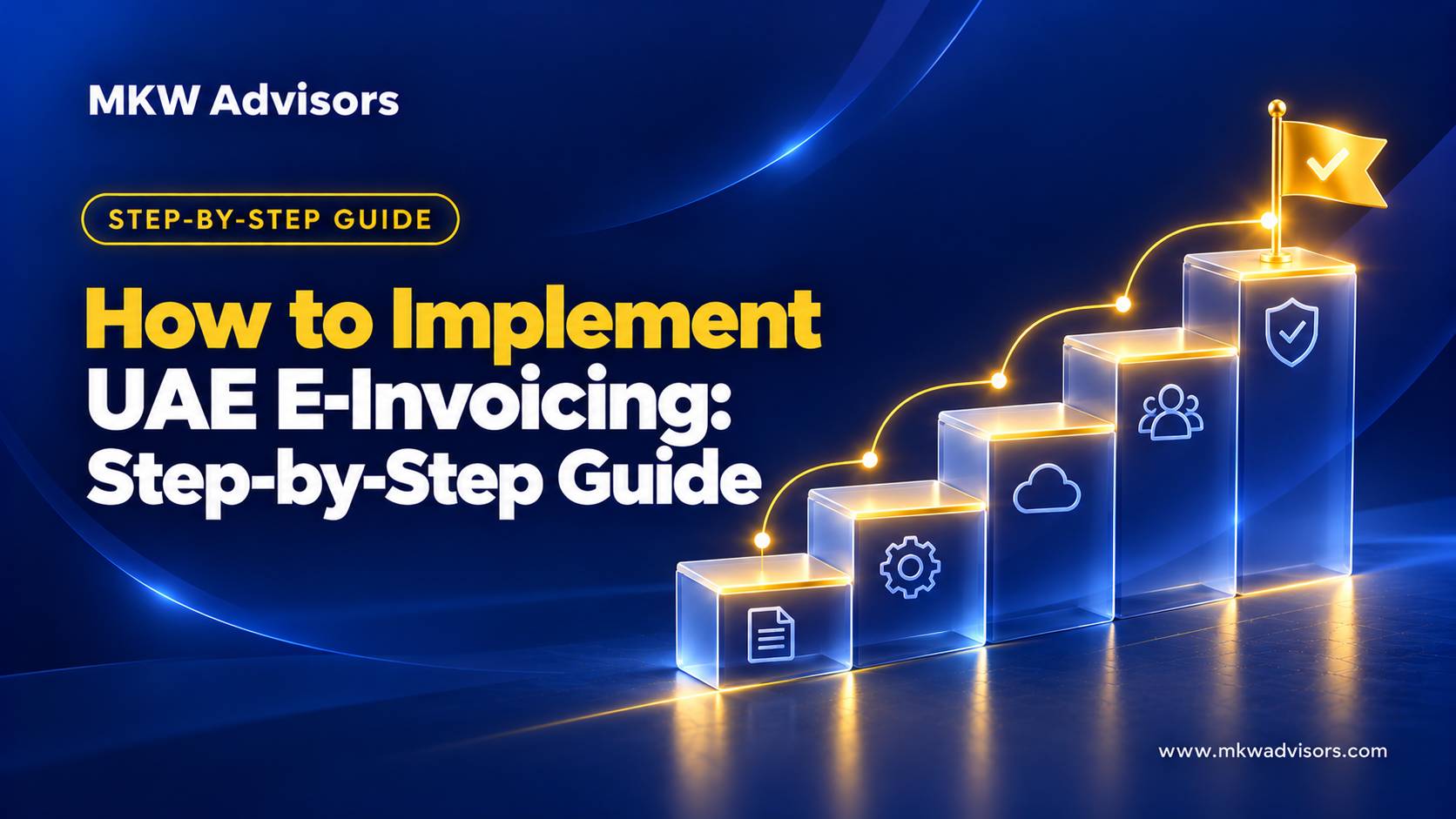
Implementing UAE e-invoicing takes six steps: confirm scope and dates, map invoice workflows, select an Accredited Service Provider, clean and map data to PINT AE, test normal and exception cases, then train staff and monitor after go-live. Most single-entity businesses need 3–5 months; multi-entity or custom-ERP groups need longer.
Why this matters now. The steps are sequential: you cannot map data before you know the flows, or test before you have an ASP. Starting step 1 this quarter is what makes a 2027 go-live calm instead of rushed.
Step 1: Confirm scope and dates (2–4 weeks)
List entities, transaction flows, phase dates and potential exclusions. Appoint a project owner and name contacts in finance, operations and IT. Output: a one-page scope note with sources.
Step 2: Map workflows (2–3 weeks)
Document how invoices and credit notes are created, approved, sent, received, corrected and stored, including spreadsheets and manual workarounds. Output: a flow map per entity.
Step 3: Select an ASP (3–6 weeks)
Verify accreditation in the MoF directory. Compare supported flows, integrations, onboarding, security, data access, support and total cost. Output: signed scope and fee schedule.
Step 4: Clean and map data (4–8 weeks)
Fix customer and vendor records, tax identifiers, item descriptions, units, amounts, tax codes and currencies. Map each source field to the required PINT AE field. Output: a field-mapping document and a cleaned master data set.
Step 5: Test (4–8 weeks)
Test standard invoices, credit notes, missing fields, rejections, duplicates and outages end-to-end with the ASP. Log every defect and retest. Output: signed test report.
Step 6: Train, go live, monitor (2 weeks + ongoing)
Train staff, document escalation, obtain sign-off, then monitor rejections, exceptions and data quality daily for the first month.
Worked example: a 16-week single-entity plan
| Weeks | Step | Output |
|---|---|---|
| 1–2 | Scope and owner | Scope note |
| 3–4 | Workflow map | Flow diagram per channel |
| 4–7 | ASP comparison and contract | Signed scope and fees |
| 6–11 | Data cleanup and mapping | Clean masters, mapping document |
| 10–15 | Testing | Signed test report |
| 15–16 | Training and go-live | Escalation path, monitoring |
Steps overlap on purpose: ASP comparison starts while the workflow map is finishing, and data cleanup starts before the contract is signed because the fields to fix are the same whichever ASP is chosen.
What goes wrong most often?
A second invoicing channel (a point-of-sale system, a subscription tool, a spreadsheet) surfaces in testing because the workflow map was skipped. Credit notes are tested last and fail because the reference to the original invoice is missing. A field mapping is changed in production to fix one invoice and breaks a hundred. Each of these is prevented by doing the step before it properly.
Mistakes to avoid
- Skipping the workflow map and discovering a hidden invoicing channel in testing.
- Mapping fields before master data is clean.
- Treating “the ASP demo worked” as testing.
Frequently asked questions
How long does UAE e-invoicing implementation take? There is no fixed duration. Single-entity businesses with clean data often need 3–5 months; complex groups need more.
Can we skip testing if the ASP is accredited? No. Accreditation covers the provider, not your data, integration or workflows. Test your actual flows.
Who should own the e-invoicing project? A finance lead with authority over master data, supported by IT and operations, and a deputy for continuity.
Key takeaways
- Six sequential steps: scope → workflows → ASP → data → test → go-live.
- Data cleanup and testing take the longest; start them early.
- Each step has a written output that doubles as your compliance evidence.
How MKW Advisors can help
Want steps 1, 2 and 4 handled by an accounting team? MKW Advisors scopes entities, maps workflows and cleans Zoho Books data so your ASP integration starts on solid ground. WhatsApp +91 96677 44073. Next read: What Is an ASP? (Blog 10).
If your business is reviewing UAE e-invoicing readiness, accounting workflows, Zoho Books setup or monthly bookkeeping, MKW Advisors can discuss your requirements and the support that may be appropriate. Any e-invoicing network services should be provided through a service provider whose current accreditation has been verified in the official UAE Ministry of Finance directory.
Call or WhatsApp MKW Advisors: +91 96677 44073
This article is for general information only and is not legal, tax or accounting advice for a specific transaction. Requirements may change. Confirm current rules and obtain qualified professional advice where needed.
Related guides
- UAE E-Invoicing 2026–2027: Complete Guide for Businesses
- E-Invoicing Implementation Services in Dubai: What to Look For
Official sources and further reading
- UAE Ministry of Finance — official eInvoicing portal and guidance
- MoF — Accredited eInvoicing Service Providers directory
- MoF — October 2026 amendment to eInvoicing regulations
- MoF — UAE 4-corner eInvoicing model
- MoF — ASP accreditation framework update, October 2026
- UAE Federal Tax Authority — eInvoicing