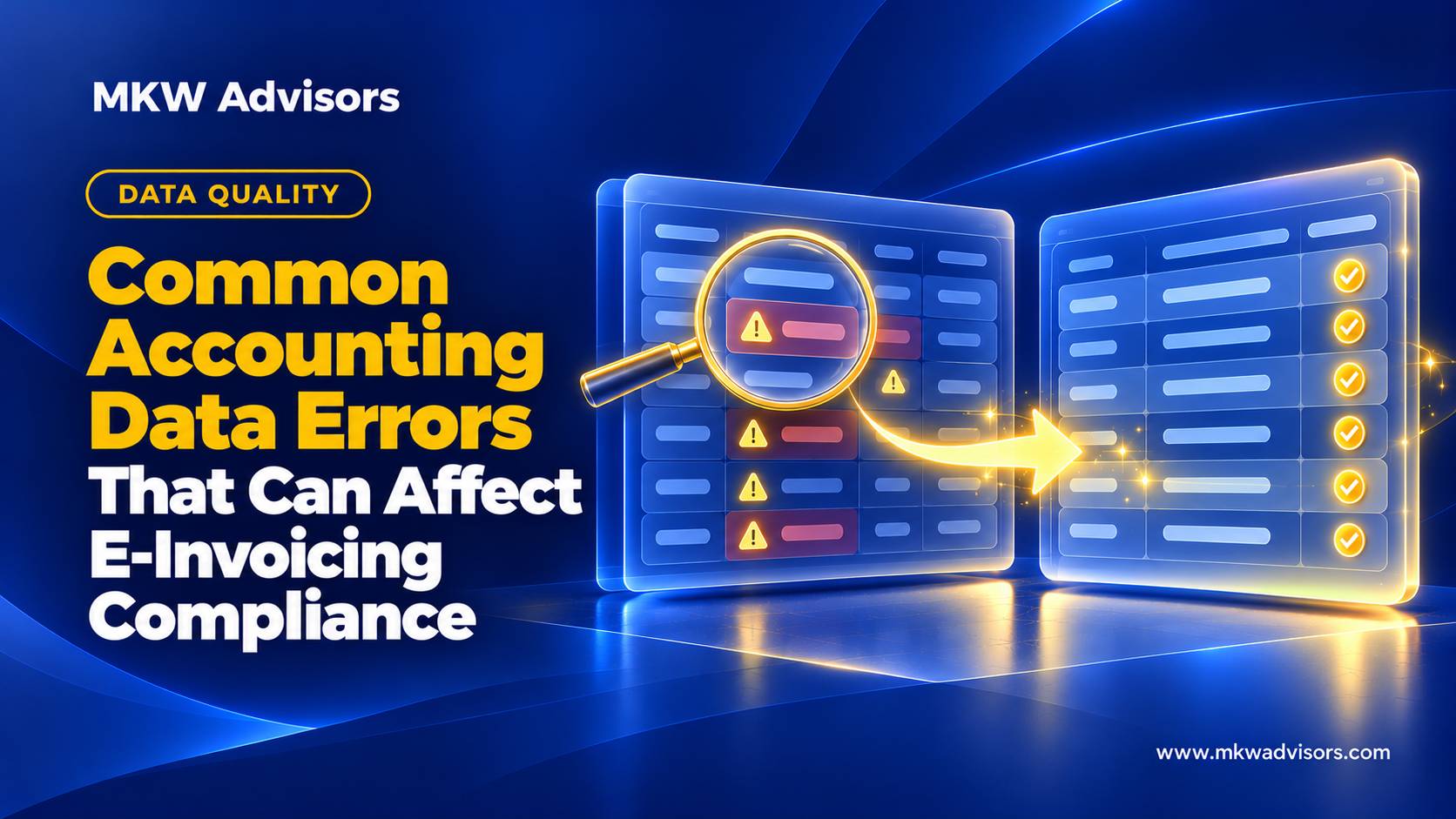
Structured e-invoicing rejects what people used to overlook. The eight errors that most often cause rejections or wrong structured data are missing legal names or addresses, missing identifiers, inconsistent tax codes, inconsistent item descriptions and units, rounding and currency-precision mismatches, credit notes without a reference, duplicate customer or item records, and field-mapping mistakes. All eight live in master data and process, and all are fixable before go-live.
Why this matters now. An invoice that looks right on screen can carry invalid structured data. Every error found in testing in 2026 is one that will not stop cash collection in 2027.
The eight errors and their fixes
| # | Error | Fix |
|---|---|---|
| 1 | Missing legal name or address on a customer or vendor | Define required fields; block invoicing on incomplete contacts |
| 2 | Missing or wrong identifiers where required | Validate on entry; review all active contacts once |
| 3 | Inconsistent tax codes across teams | One tax-code list, one owner, qualified review of uncertain treatment |
| 4 | Inconsistent item descriptions and units | Standardize the item master; retire free-text lines |
| 5 | Rounding and currency precision mismatches | Test discounts, multi-currency and totals against the structured output |
| 6 | Credit notes without a reference to the original invoice | Make the reference mandatory in the workflow |
| 7 | Duplicate customers, items or old addresses | Merge duplicates; archive inactive records |
| 8 | Field-mapping mistakes | Keep a mapping document; test every change before production |
Where should a business start?
Sample 30 real invoices and credit notes, log every recurring error against the eight categories and fix the two most frequent first. Repeat monthly until the sample is clean.
Will the ASP catch these?
Validation flags some issues at transmission, but a flagged invoice is a delayed invoice. Source data and internal controls prevent the delay.
Worked example: a 30-invoice audit
A facilities company samples 30 invoices and 10 credit notes. Findings: 11 invoices to customers with a trading name instead of a legal name (error 1), 6 with a tax code that differs from the same service on other invoices (error 3), 4 credit notes with no original-invoice reference (error 6), and 3 duplicate customer records found on the way (error 7). Errors 1 and 3 are the top two, so the first fortnight goes to completing legal names and agreeing one tax code per service. A second sample a month later shows error 1 gone and error 3 down to one case.
Why these errors hide in ordinary accounting
A PDF invoice with a trading name still gets paid. A tax code that is wrong on one line still produces a correct-looking total. A credit note without a reference still reduces the balance. None of these interrupts a human workflow, so nobody fixes them. Structured exchange interrupts, which is uncomfortable in testing and valuable in production.
Mistakes to avoid
- Fixing errors invoice by invoice instead of in the master data.
- Letting several teams edit tax codes.
- Changing mappings in production without a test.
Frequently asked questions
Will an ASP fix our accounting data errors? No. It may flag them, but correction and prevention happen in your master data and processes.
What is the most common e-invoice rejection reason? Incomplete party data and inconsistent tax coding are the usual leaders; sample your own invoices to confirm.
How often should we review master data? Monthly during preparation, then quarterly, with a named owner.
Key takeaways
- Eight errors cause most rejections; all sit in master data and workflow.
- Sample, log, fix the top two, repeat.
- Validation delays bad invoices; controls prevent them.
How MKW Advisors can help
Want a 30-invoice data audit with a prioritized fix list? WhatsApp MKW Advisors on +91 96677 44073. We run it inside your Zoho Books or ERP and clean the master data with you. Next read: How Much Does Implementation Cost? (Blog 23).
If your business is reviewing UAE e-invoicing readiness, accounting workflows, Zoho Books setup or monthly bookkeeping, MKW Advisors can discuss your requirements and the support that may be appropriate. Any e-invoicing network services should be provided through a service provider whose current accreditation has been verified in the official UAE Ministry of Finance directory.
Call or WhatsApp MKW Advisors: +91 96677 44073
This article is for general information only and is not legal, tax or accounting advice for a specific transaction. Requirements may change. Confirm current rules and obtain qualified professional advice where needed.
Related guides
- UAE E-Invoicing 2026–2027: Complete Guide for Businesses
- E-Invoicing Implementation Services in Dubai: What to Look For
Official sources and further reading
- UAE Ministry of Finance — official eInvoicing portal and guidance
- MoF — Accredited eInvoicing Service Providers directory
- MoF — October 2026 amendment to eInvoicing regulations
- MoF — UAE 4-corner eInvoicing model
- MoF — ASP accreditation framework update, October 2026
- UAE Federal Tax Authority — eInvoicing