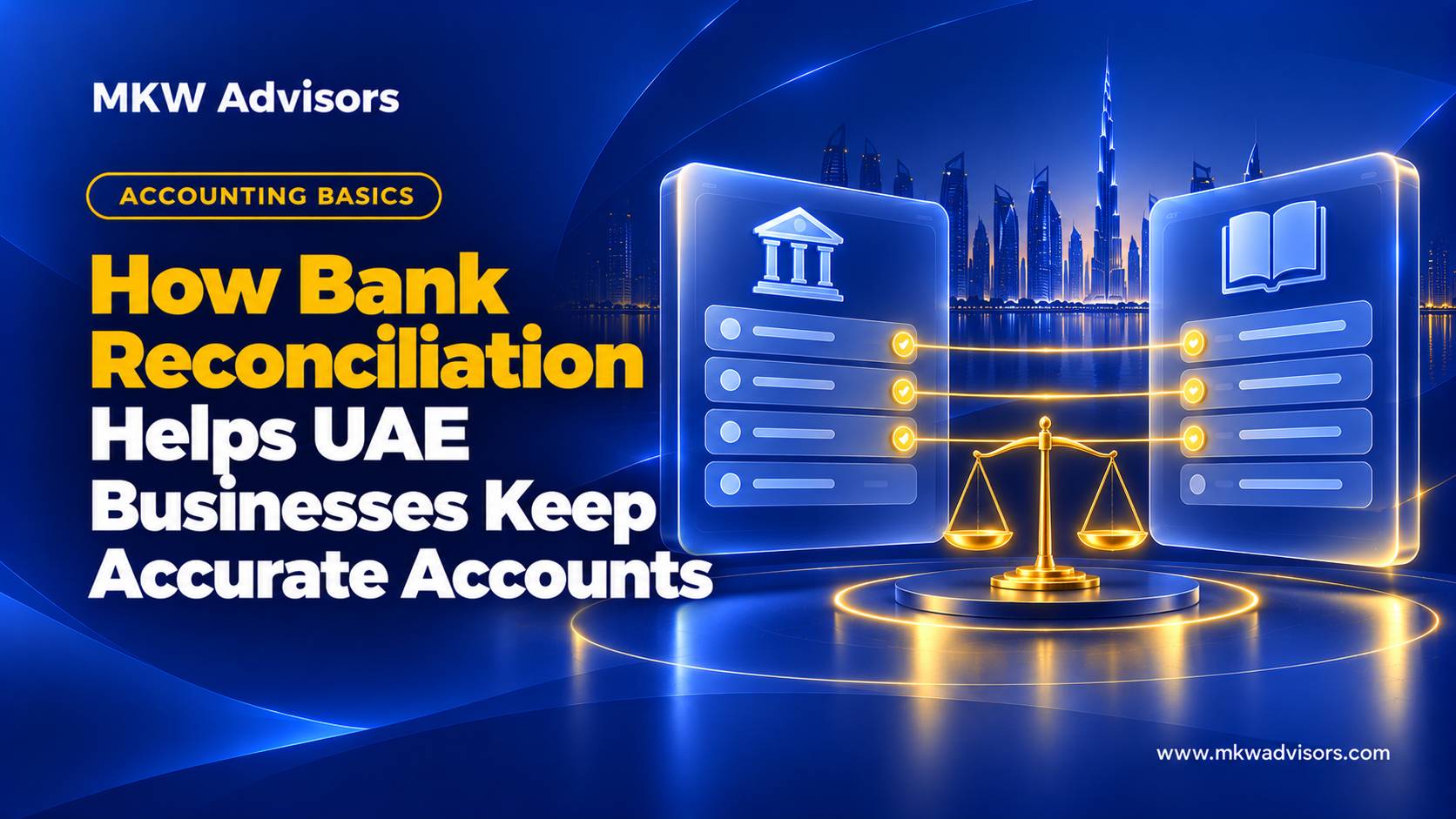
Bank reconciliation compares your accounting records with your bank statement to find missing entries, duplicates, incorrect amounts and timing differences. It is a core control, not a month-end chore: without it, the cash balance in your reports can differ from the cash in the bank, and that gap hides fees, refunds, unrecorded receipts and errors.
Why this matters now. Reconciliation is the one routine that proves the ledger reflects reality. Businesses heading into e-invoicing with unreconciled accounts are carrying unknown errors into a system that will make them visible.
Why does reconciliation matter?
Reports are only as good as the cash they stand on. Unreconciled accounts overstate or understate cash, distort profit and leave receivables wrong, which affects every decision taken on those numbers.
A 5-step process
- Import or feed the bank statement for the period.
- Match known transactions to ledger entries.
- Record legitimate bank charges, interest and transfers.
- Investigate every unmatched item; do not force the difference to zero.
- Document unresolved items with an owner and a date.
The seven most common exceptions
| Exception | Usual cause |
|---|---|
| Duplicate entries | Bill or receipt recorded twice |
| Unallocated receipts | Customer paid without reference |
| Supplier paid twice | Weak approval or duplicate bill |
| Payments in transit | Timing difference across period end |
| Bank charges and FX fees | Not recorded in the ledger |
| Returned or failed payments | Reversed by the bank, not the ledger |
| Wrong account posting | Transfer booked as income or expense |
How does it support e-invoicing?
Reconciliation does not exchange invoices, but it keeps customer balances, credit notes and payments accurate, which is the data an e-invoicing system relies on. A reconciled ledger produces fewer corrections after go-live.
Worked example: the AED 4,200 difference
A clinic’s ledger showed AED 4,200 more cash than the bank. The temptation was a “rounding” adjustment. Investigation found a card-gateway payout recorded at gross while the bank received it net of fees, a patient refund processed by the bank but never entered, and a supplier payment posted to the wrong month. Three real entries, three corrected balances, and a gateway-fee process that now records fees automatically. The adjustment would have hidden all three.
Reconciling more than the main account
Payment gateways, petty cash, credit cards and any account that moves money needs the same treatment. Gateways in particular: reconcile the payout to the individual transactions, not just the total, so fees and chargebacks are visible.
Mistakes to avoid
- Assuming a bank feed means reconciled.
- Writing off differences as “rounding”.
- Reconciling only the main account and ignoring gateways and petty cash.
Frequently asked questions
Does a bank feed eliminate bank reconciliation? No. The feed imports data; matching, classification and investigation still need a person.
How often should a UAE business reconcile its bank? At least monthly; weekly for high-volume businesses.
Can bank reconciliation help with e-invoicing? Indirectly. It keeps balances, credit notes and payments accurate, which reduces corrections once invoices are exchanged electronically.
Key takeaways
- Reconciliation proves cash and keeps reports honest.
- Five steps, seven usual exceptions, never force to zero.
- Accurate ledgers mean fewer e-invoicing corrections.
How MKW Advisors can help
Behind on reconciliations or unsure your balances are right? MKW Advisors catches up and maintains bank reconciliations as part of monthly bookkeeping. WhatsApp +91 96677 44073. Next read: Outsourced Bookkeeping in the UAE (Blog 27).
If your business is reviewing UAE e-invoicing readiness, accounting workflows, Zoho Books setup or monthly bookkeeping, MKW Advisors can discuss your requirements and the support that may be appropriate. Any e-invoicing network services should be provided through a service provider whose current accreditation has been verified in the official UAE Ministry of Finance directory.
Call or WhatsApp MKW Advisors: +91 96677 44073
This article is for general information only and is not legal, tax or accounting advice for a specific transaction. Requirements may change. Confirm current rules and obtain qualified professional advice where needed.
Related guides
- UAE E-Invoicing 2026–2027: Complete Guide for Businesses
- E-Invoicing Implementation Services in Dubai: What to Look For
Official sources and further reading
- UAE Ministry of Finance — official eInvoicing portal and guidance
- MoF — Accredited eInvoicing Service Providers directory
- MoF — October 2026 amendment to eInvoicing regulations
- MoF — UAE 4-corner eInvoicing model
- MoF — ASP accreditation framework update, October 2026
- UAE Federal Tax Authority — eInvoicing